
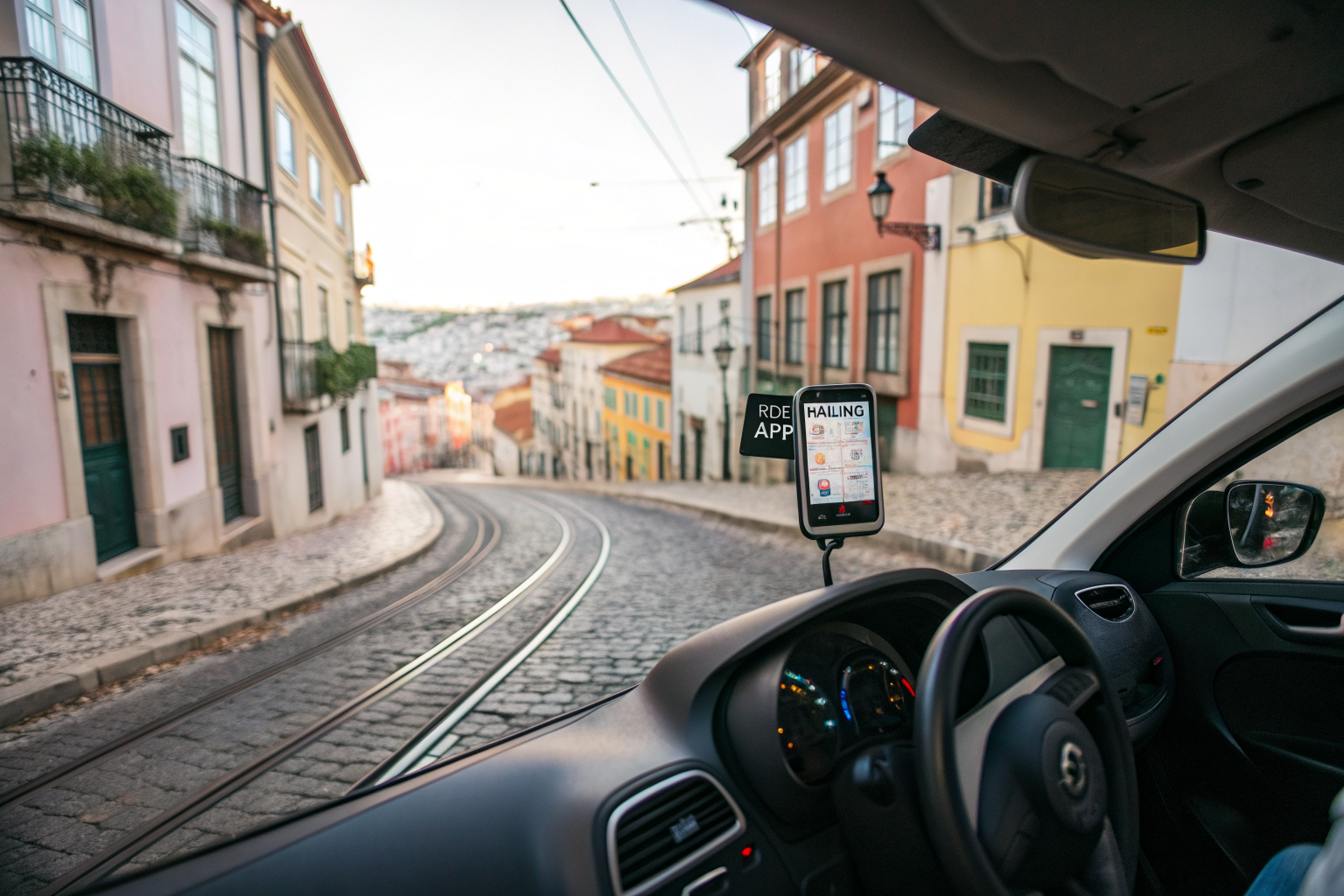
If you need a taxi app in Lisbon, the two most useful options are Uber and Bolt. For most visitors, Bolt is often the cheaper option for everyday rides, while Uber usually feels a little more familiar and more consistent, especially if you already use it in other countries.
Taxi apps are especially useful in Lisbon because the city is full of steep hills, cobbled streets, and neighborhoods where a short walk can turn into an exhausting climb. They are not just convenient here — they are often the easiest way to deal with luggage, late-night returns, airport transfers, and awkward uphill routes.
In this guide, I’ll show you which taxi app works best in Lisbon, how Uber and Bolt compare, what to expect at the airport, how pricing works, and when it still makes sense to use a regular taxi instead.
Quick answer
- Best all-round app: Uber
- Best for lower prices: Bolt
- Best strategy: install both apps and compare before each ride
- Most useful for: airport transfers, hills, luggage, and late-night rides
Introduction to taxi apps in Lisbon
Lisbon is one of those cities where taxi apps quickly become part of your routine. Not because public transport is bad — it isn’t — but because the city’s hills, cobbled streets, and uneven layouts make some short journeys feel much harder than they look on the map.
That is especially true if you are arriving with luggage, staying in an older neighborhood, or returning to your hotel after a long day of walking. In many cases, a taxi app is not about luxury at all. It is simply the easiest way to get from one part of Lisbon to another without turning a short trip into a sweaty uphill climb.
For most travelers, the best setup is simple: install Uber and Bolt before your trip, then compare both when you need a ride. That gives you flexibility, lets you check prices in real time, and makes the city much easier to navigate from the moment you land.
When a taxi app makes sense in Lisbon

Lisbon is a city where transport choices depend a lot on terrain, energy, and timing. The metro is useful, trams can be charming, and walking is often the best way to enjoy the city — but none of those options solves every route equally well. That is where taxi apps become useful.
They are most worth using when convenience matters more than saving a few euros. That usually means airport rides, rainy days, late-night returns, journeys with luggage, and routes that end with a steep climb. Even travelers who mostly rely on public transport often use Uber or Bolt once or twice a day in Lisbon because they make the trickiest parts of the city much easier.
| Transport option | Best for | Main downside |
|---|---|---|
| Uber / Bolt | Door-to-door rides, hills, luggage, airport transfers | Can cost more at busy times |
| Metro | Cheap and efficient longer routes | Does not solve the final uphill walk |
| Tram | Scenic central routes | Often slow and crowded |
| Walking | Short distances and sightseeing | Can be tiring on Lisbon’s hills |
In practice, the best way to get around Lisbon is often to mix transport types. You might take the metro across the city, walk through the center, then use a taxi app for the final uphill stretch back to your hotel.
Where you stay makes a big difference to how often you’ll rely on ride-hailing, which is why it helps to understand Lisbon neighborhoods before booking accommodation.
The main taxi apps in Lisbon
If you are wondering which taxi app to use in Lisbon, the short answer is this: download Uber and Bolt. These are the two platforms most travelers actually use, and together they cover almost everything you need for moving around the city.
Uber is usually the easiest default option for visitors because the app feels familiar, the ride flow is smooth, and many travelers already have it installed. Bolt, on the other hand, is often the one that gives a better fare for the same route, which makes it especially useful for budget-conscious travelers.
There are also other options, including platforms connected to licensed taxis, but for most tourists those are backup choices rather than the main ones to rely on. If you only want the simplest and most practical setup, Uber and Bolt are enough.
Top taxi apps in Lisbon compared
For most travelers, the decision is less about choosing one “winner” and more about knowing when each app makes the most sense. In Lisbon, the best results usually come from comparing both before you book.
| App | Best for | Strengths | Possible downside |
|---|---|---|---|
| Uber | Travelers who want a familiar and smooth experience | Easy to use, comfortable default choice, useful for airport rides | Often slightly more expensive |
| Bolt | Travelers who want lower prices | Usually cheaper for everyday city rides | Ride quality can feel a bit less consistent |
| FREENOW / local taxi apps | People who prefer booking licensed taxis in-app | Taxi-style service through an app | Not usually the first choice for most visitors |
If you only want one practical takeaway, it is this: Bolt often wins on price, while Uber often wins on ease and familiarity. That is why many travelers keep both on their phone and compare them each time.
Electric and sustainable ride options in Lisbon
Some ride-hailing categories in Lisbon may include greener vehicle options, which can be a nice bonus if you prefer a lower-impact ride. Still, for most travelers, the main decision usually comes down to fare, waiting time, and pickup convenience rather than the exact vehicle type.
If sustainability matters to you, it is worth checking the vehicle categories shown in the app before booking. But for everyday city use, Uber and Bolt are most helpful because they solve the practical problem of getting across Lisbon quickly and easily.
Useful features that make taxi apps easier to use
One of the reasons taxi apps work so well in Lisbon is that they remove a lot of small travel frictions. You do not need to explain your destination in person, worry about having the right cash, or guess whether the car outside is actually yours.
- Driver name, car model, and license plate shown before pickup
- Live route tracking during the ride
- Cashless payment by card or wallet
- In-app messaging if the pickup point is confusing
- Trip sharing for late-night rides
These features are especially useful at the airport, in busy tourist areas, and in older neighborhoods where streets can be narrow and pickup points are not always obvious.
When to use Uber, Bolt, or a regular taxi in Lisbon
There is no single app that is best in every situation, but some patterns become clear once you start using them around the city. For normal rides, Bolt is often worth checking first because it can be cheaper. Uber is a strong default if you want a familiar experience or need a slightly smoother ride flow. A regular taxi is still an option if you prefer traditional service, but most visitors find app-based rides easier.
- Check Bolt first if your priority is price.
- Check Uber first if you want a familiar and easy booking experience.
- Compare both again on rainy days, weekends, and late nights.
- Use a regular taxi only if that feels more comfortable to you or you want a licensed taxi specifically.
In practice, the best taxi app in Lisbon is usually the one that gives you the better combination of waiting time, fare, and pickup convenience at that exact moment.
Popular routes and trip planning with taxi apps
Some rides come up again and again for visitors. These are the journeys where taxi apps feel most useful — either because they save time, avoid hills, or make the route much easier with luggage.
| Route | Why people use a taxi app | Best tip |
|---|---|---|
| Airport to Baixa / Chiado | Direct, easy, and much more comfortable with luggage | Compare Uber and Bolt before booking |
| Baixa to Belém | Convenient if you do not want transport changes | Good option when you are short on time |
| Alfama / Graça / Bairro Alto | Helps avoid steep uphill walks | Use a nearby landmark if the street is hard to access |
| City to Cascais or Sintra | Comfortable but less budget-friendly than public transport | Best when convenience matters more than cost |
For short central rides, the biggest value of a taxi app is often not speed but energy saved. In Lisbon, a short ride can feel very worthwhile if it means avoiding one more hill at the end of the day.
Taxi apps are also practical for reaching day trip departure points from Lisbon, especially for early starts or when you are carrying bags.
Airport transfers: what to know before you land
For many travelers, the first time they use a taxi app in Lisbon is right after landing. And in most cases, it is the easiest option. You do not need cash, you do not need to explain your route in person, and you can go directly to your accommodation without dragging luggage through stations or uphill streets.
Both Uber and Bolt are useful for airport transfers, so the best approach is usually to open both apps and compare the price and wait time before confirming. That gives you flexibility straight away and reduces the chance of overpaying.
The most important thing is to follow the pickup instructions shown inside the app carefully. Airport pickups do not work like normal street pickups, so it is much easier if you rely on the app’s meeting-point guidance rather than guessing where the driver will stop.
- Check the pickup instructions carefully after booking
- Verify the car and plate number before entering
- Allow extra time during peak arrivals or bad weather
- Keep both Uber and Bolt installed as backup options
For departures, taxi apps are just as useful — especially if you are staying in a hillier neighborhood or flying early in the morning. They remove a lot of small stress points and make airport planning feel much simpler.
If you are staying in the Lisbon city centre, app-based airport transfers are often the easiest start and finish to your trip.
Pricing and payment: what travelers should expect
One of the biggest reasons travelers prefer taxi apps in Lisbon is that the price is usually shown before the ride starts. That makes the whole experience feel much easier, especially when you are new in the city and do not want to think about route choices, traffic, or cash.
In many cases, Bolt is slightly cheaper than Uber for ordinary city rides. But the difference is not always huge, and it can change depending on demand, time of day, and pickup location. The simplest habit is to compare both before every ride instead of assuming one app will always be cheaper.
Prices often rise when demand is high. Rain, busy evenings, airport rushes, and late-night returns can all make fares jump. That does not mean ride-hailing stops being useful — just that it becomes more important to check both apps and decide whether the convenience is worth it in that moment.
- You usually see the estimated fare before booking
- Card payment is the easiest option for visitors
- Digital wallets may also be available depending on the app
- Busy periods can increase prices
- Comparing Uber and Bolt is the easiest way to avoid overpaying
After the ride, it also helps to know how tipping works in Lisbon, especially if a driver helps with luggage or waits at a tricky pickup point.
Simple ways to spend less on taxi apps in Lisbon
You do not need any complicated strategy to save money on ride-hailing in Lisbon. A few small habits are enough, and the easiest one is comparing both apps before every ride.
- Install both Uber and Bolt before your trip
- Compare every ride instead of defaulting to one app
- If prices look high, wait a few minutes and check again
- Walk to a clearer pickup point in very busy areas
- Use taxi apps mainly for hills, luggage, rain, and late-night returns
In Lisbon, saving money is often less about hunting for deals and more about using ride-hailing strategically. A short app ride can be well worth the cost if it saves you from an exhausting uphill walk at the end of the day.
Where taxi apps work best in Lisbon
Taxi apps work best in central Lisbon, where driver availability is usually strongest and most visitors spend their time. In areas like Baixa, Chiado, and much of the central city, getting a ride is normally straightforward and quick.
In older neighborhoods such as Alfama, Graça, or parts of Bairro Alto, the main challenge is often not whether the app works but whether the driver can stop exactly at your door. Some streets are narrow, steep, or hard to access, so it often helps to use a nearby landmark or wider road as your pickup point.
Farther outside the center, rides are still possible, but availability can feel less predictable, especially very early in the morning or late at night. That does not make the apps unreliable — it just means it is wise to leave more time and keep both options ready.
| Area | What to expect | Best approach |
|---|---|---|
| Baixa / Chiado | Usually easy pickups | Compare both apps and choose the better fare |
| Alfama / Graça | Access can be tricky | Use a nearby landmark or wider pickup point |
| Bairro Alto | Good coverage, busy at night | Expect more demand in the evening |
| Outer districts | Possible longer waits | Leave extra time |
If you plan to stay in the historic core, it helps to understand the layout of Lisbon old town before expecting exact door-to-door pickups everywhere.
What if you do not speak Portuguese?
One of the best things about using a taxi app in Lisbon is that you do not need much Portuguese to get around. You enter the destination in the app, the route appears on the map, and payment happens digitally, which removes most of the awkward parts of organizing transport in a new city.
If the pickup point is confusing, use the in-app chat and keep your message simple. In older neighborhoods, sharing a nearby landmark is often more useful than repeating a full address that may be difficult for a driver to reach exactly.
For many visitors, that is one of the biggest reasons ride-hailing feels easier than trying to organize a taxi on the street.
Are taxi apps safe in Lisbon?
For most visitors, taxi apps in Lisbon feel safe and straightforward to use. The main reason is transparency: before the ride starts, you can already see the driver details, vehicle information, route, and payment flow inside the app. That usually feels much easier than dealing with transport uncertainty after a long day or late at night.
- Check the driver name, car model, and plate number before entering
- Use the route tracking shown in the app
- Share your trip with someone if you are traveling late at night
- Book only through the app and avoid unofficial offers
As in any large city, basic travel common sense still matters. But overall, Uber and Bolt are among the easiest and most transparent ways to get around Lisbon, especially when you want a direct ride back to your accommodation without unnecessary friction.
Taxi apps are especially useful for late returns from nightlife areas like Pink Street, when convenience and route visibility matter most.
Accessibility and practical limits
Taxi apps can be especially helpful for travelers with mobility concerns because they reduce the need to deal with steep climbs, uneven pavements, and longer walks between transport connections. That said, Lisbon’s layout can still make pickups more complicated in older neighborhoods, so it helps to choose clear and accessible meeting points whenever possible.
Even if you do not rely on ride-hailing for every journey, it can make Lisbon much easier to manage when comfort and direct access matter more than saving a small amount of money.
Alternatives to taxi apps in Lisbon
Taxi apps are useful, but they are not the only way to get around Lisbon. For many travelers, the best approach is mixing options depending on the route, time of day, and how much energy you still have left.
| Option | Best for | Main limitation |
|---|---|---|
| Metro | Cheap and efficient longer routes | Does not solve the final uphill walk |
| Tram | Scenic central routes | Often crowded and slow |
| Regular taxi | Traditional taxi service | Less price clarity than apps |
| Walking | Exploring central neighborhoods | Can be tiring on steep streets |
If budget matters most, public transport usually wins. But if your goal is to make Lisbon feel easier, less tiring, and more flexible, taxi apps are often worth using selectively.
Frequently Asked Questions
For most tourists, the best setup is to install both Uber and Bolt. Bolt is often cheaper, while Uber often feels more familiar and slightly more consistent. The best choice depends on the fare and waiting time at the moment you book.
Very often, yes. Bolt is frequently cheaper for everyday city rides, but not always. The easiest way to save money is to compare both apps before confirming the ride.
Yes. Uber and Bolt are both useful for airport transfers in Lisbon. After booking, follow the pickup instructions in the app carefully rather than assuming pickup works like a normal street ride.
For most visitors, a taxi app is easier because you can see the estimated fare, track the route, and pay in the app. A regular taxi can still be useful, but apps usually feel simpler and more transparent.
Usually no. Card payment is the easiest option for visitors, and that is one of the main reasons many travelers prefer Uber or Bolt over organizing transport on the street.
Yes. Many travelers walk most of the day and only use a taxi app for airport transfers, rainy evenings, steep uphill returns, or late-night rides back to their hotel.
