
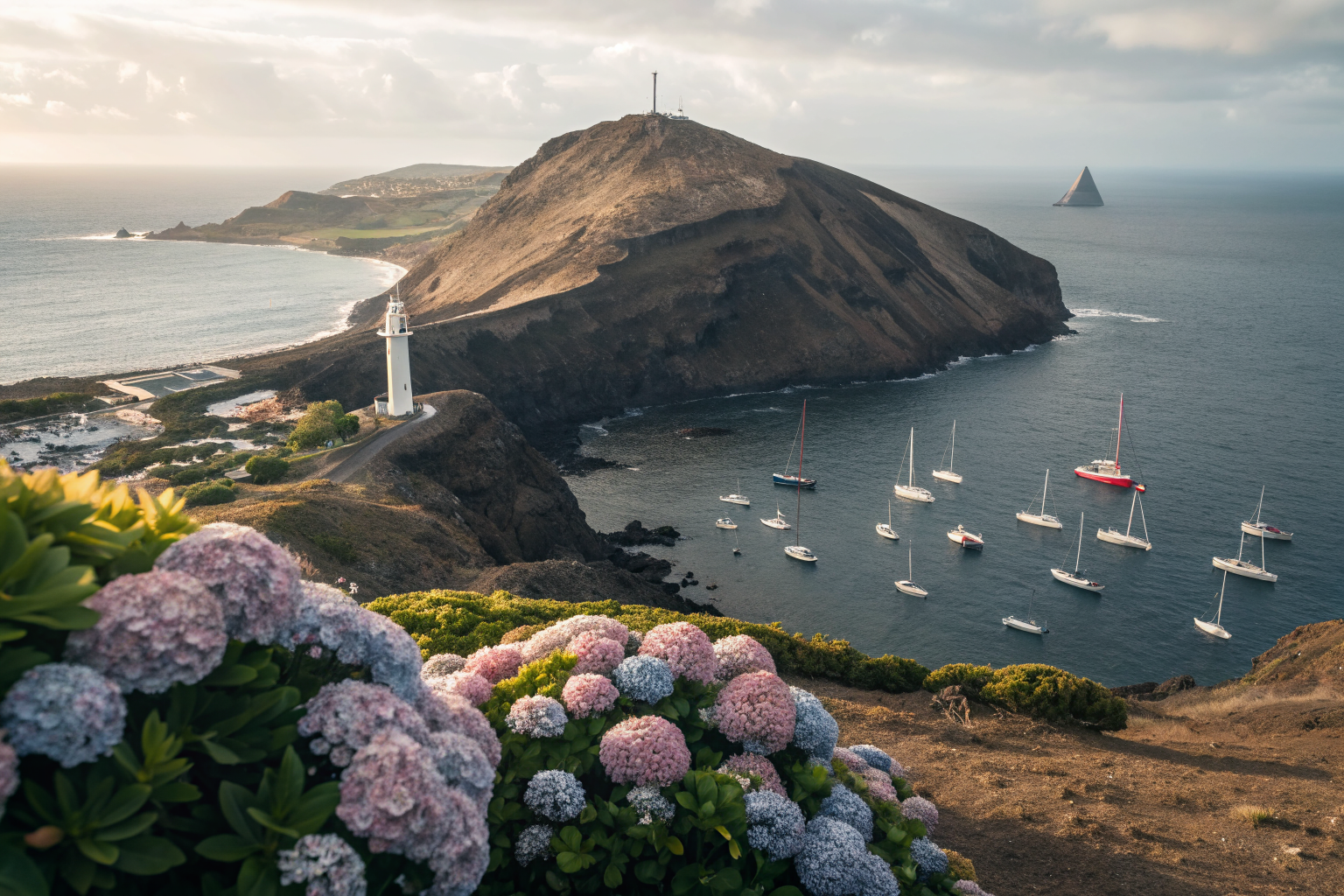
The best things to do in faial azores range from exploring dramatic volcanic landscapes to soaking in rich maritime history. Known as the “Blue Island,” Faial offers visitors unique geological sites like the Capelinhos Volcano and the massive Caldeira crater. It is also a world-renowned hub for transatlantic sailors, with the colorful marina in Horta serving as a central point for culture, dining, and adventure, making it a diverse destination for nature lovers and history buffs alike.
Key Benefits at a Glance
- Explore Unique Volcanic Landscapes: Witness the raw power of nature at the Capelinhos Volcano Interpretation Centre and the stunning Caldeira.
- Discover Rich Maritime History: Stroll through the iconic Horta Marina, famous for its sailors’ murals, and visit Peter’s Café Sport.
- Enjoy World-Class Whale Watching: Embark on a tour to see majestic whales and playful dolphins in their natural Atlantic habitat.
- Hike Breathtaking Natural Trails: Traverse well-marked paths around the Caldeira or along the coast for unforgettable panoramic views.
- Relax in Natural Swimming Pools: Swim in the safe and scenic lava rock pools at Varadouro for a refreshing and unique coastal experience.
Purpose of this guide
This guide is for travelers planning a trip to Faial, whether it’s their first visit or they are looking for new ideas. It solves the challenge of prioritizing activities on an island packed with natural wonders and cultural gems. Here, you will find a curated look at the can’t-miss attractions, helping you plan an efficient itinerary that balances adventure with relaxation. We’ll highlight the most memorable experiences, from geological marvels to local traditions, ensuring you make the most of your time on the beautiful Blue Island and avoid missing out on its essential sights.
15 unforgettable things to do in Faial: The Azores' volcanic paradise

When I first stepped off the ferry onto Faial Island, I knew I'd discovered something special within the Azores archipelago. This captivating island, affectionately known as the Blue Island, offers an incredible blend of volcanic landscapes, world-class whale watching, and authentic Portuguese culture that rivals any destination in the Atlantic. Located just 30 minutes by ferry from Pico Island, Faial serves as the perfect base for exploring the central Azores, with Horta as its charming harbor town and gateway to adventure.
What makes Faial truly unique among the Azores islands is its remarkable diversity packed into just 173 square kilometers. From the otherworldly lunar landscapes of Capelinhos to the lush green crater of Caldeira, from the bustling international marina to peaceful hiking trails, this island delivers experiences that satisfy every type of traveler. During my week-long stay, I discovered that 2-3 days barely scratches the surface of what Faial offers, though it's enough time to hit the major highlights and fall in love with this volcanic paradise.
Why I fell in love with Faial: The Blue Island of the Azores
My ferry journey from Pico to Faial Island began with anticipation, but nothing prepared me for the wall of blue that greeted me as we approached Horta. The Blue Island nickname isn't just poetic marketing – it's a living, breathing reality that transforms the landscape each summer. Thousands of hydrangeas line the roads, stone walls, and hillsides, creating an ethereal blue carpet that seems to flow from the mountains to the sea.
What struck me immediately about Faial was its authentic character within the broader Azores context. While São Miguel attracts most visitors with its famous hot springs and crater lakes, Faial offers something more intimate and genuine. The Azores archipelago reveals its true personality here, where international sailors mingle with local fishermen at waterfront cafes, and volcanic ash fields meet perfectly manicured hydrangea gardens.
Horta became my instant favorite among all the towns I've visited in the Azores. Unlike the tourist-focused areas of other islands, Horta maintains its working harbor atmosphere while embracing its role as a crucial Atlantic crossing point. Walking through the marina on my first evening, surrounded by yachts from dozens of countries and the constant chatter of multiple languages, I realized I'd found a place where the world comes to visit, but the local culture remains beautifully intact.
How to get to Faial: My transportation tips
Reaching Faial Island requires some planning, but the journey becomes part of the adventure once you understand your options. From my experience navigating the logistics, there are essentially three ways to reach this Atlantic gem: flying via São Miguel with a connection, taking the frequent ferry from Pico Island, or arriving by ferry from other central Azores islands. Horta serves as the arrival point for all methods, and I quickly learned that renting a car upon arrival is essential for exploring beyond the town center.
The beauty of Faial's location within the central Azores triangle means you're never more than a few hours away from Pico or São Jorge, making it an ideal base for island hopping. During my stay, I found the transportation connections reliable and frequent enough to support spontaneous day trips, though advance booking during summer months proved crucial for securing spots.
| Transportation Method | Duration | Cost Range | Frequency | Best For |
|---|---|---|---|---|
| Flight via São Miguel | 1.5 hours total | €80-150 | Daily | International travelers |
| Ferry from Pico | 30 minutes | €5-8 | 6-8 daily | Island hoppers |
| Ferry from São Jorge | 1.5 hours | €12-18 | 2-3 daily | Extended stays |
My experience flying to Faial
Flying to Horta Airport proved surprisingly straightforward once I understood the connection system. SATA/Azores Airlines operates the only commercial flights to Faial, with all international travelers connecting through Ponta Delgada Airport on São Miguel Island. My journey from Lisbon involved a 2-hour flight to São Miguel, followed by a quick 25-minute hop to Faial – total travel time under four hours including the connection.
What surprised me most about Horta Airport was its intimate scale. This tiny facility handles just a few flights daily, with a single baggage carousel and a small waiting area that feels more like a regional bus station than an international airport. The charm lies in its efficiency – I was collecting my rental car within 15 minutes of landing, a refreshing contrast to larger airports.
Booking flights to Faial requires some strategy based on my experience. SATA often releases seats in blocks, so prices can fluctuate dramatically within days. I found the best deals by booking 2-3 months in advance and staying flexible with dates. The views during the final approach to Horta are spectacular, offering aerial perspectives of the Caldeira crater and Capelinhos volcanic fields that serve as perfect previews of what awaits on the ground.
Island hopping: My ferry adventures to Faial
The ferry connection between Pico Island and Faial became my preferred method of island hopping, and for good reason. Atlânticoline operates this route with impressive frequency, running 6-8 crossings daily during peak season between Madalena terminal on Pico and Horta ferry terminal on Faial. The 30-minute journey across the narrow channel offers stunning views of both islands and Mount Pico's towering peak.
My first ferry experience taught me valuable lessons about Azorean weather patterns. What started as a calm morning crossing turned into a white-knuckle adventure when Atlantic winds picked up, delaying our return journey by three hours. The Horta ferry terminal staff handled the situation professionally, providing regular updates and rebooking passengers on later sailings without additional fees.
| Route | Duration | Daily Frequency | Peak Season Cost | Terminal |
|---|---|---|---|---|
| Pico (Madalena) – Faial | 30 min | 6-8 trips | €6-8 | Horta Ferry Terminal |
| São Jorge – Faial | 1.5 hours | 2-3 trips | €15-18 | Horta Ferry Terminal |
| Terceira – Faial | 4 hours | 3-4 weekly | €25-30 | Horta Ferry Terminal |
The São Jorge Island connection offers another excellent option for reaching Faial, particularly if you're planning an extended stay in the central Azores. This 1.5-hour journey provides dramatic coastal views and typically runs 2-3 times daily. I found the longer crossing more comfortable for relaxing and planning my Faial itinerary, with onboard cafeteria service and comfortable seating areas.
- Book online at Atlanticoline.pt for guaranteed seats during peak season
- Arrive 30 minutes early for vehicle loading
- Pack layers – ferry decks can be windy and cool
- Download offline maps in case of weather delays
- Bring snacks – limited food service on shorter routes
Faial’s central location in the Azores “Triangle” makes it an ideal base for exploring neighboring islands—our guide to Terceira Island covers volcanic caves, UNESCO heritage, and natural pools just a short ferry ride away.
My favorite places in Horta: Faial's charming harbor town
Horta immediately won my heart as one of the most cosmopolitan small towns in the Atlantic. The Marina of Horta serves as the beating heart of this community, where centuries-old Portuguese traditions blend seamlessly with international sailing culture. Walking along the marina breakwater on my first evening, I was mesmerized by hundreds of colorful paintings covering every available surface – a tradition that transforms functional infrastructure into the world's most unique outdoor art gallery.
The famous yacht painting tradition at Horta Marina carries deep maritime superstition and practical purpose. According to local legend, any yacht crew that fails to leave their mark faces bad luck on their Atlantic crossing. What started as simple name-and-date inscriptions has evolved into elaborate murals depicting boat journeys, crew portraits, and artistic interpretations of ocean adventures. I spent hours wandering among these paintings, each telling a story of adventure and representing dreams fulfilled by ordinary people doing extraordinary things.
Peter Café Sport stands as the undisputed cultural center of Horta's sailing community and my personal favorite gathering spot on the island. This unassuming waterfront establishment has achieved legendary status among Atlantic sailors, serving as an unofficial mail drop, weather information center, and social hub for decades. The upstairs maritime museum houses an impressive collection of sailing artifacts, historical photographs, and memorabilia donated by grateful sailors from around the world.
- Marina paintings tradition: Every yacht crew must paint their boat’s mark or face bad luck
- Peter Café Sport houses a maritime museum upstairs with sailing artifacts
- Best marina viewing time is early morning or late afternoon for photography
- The gin and tonic at Peter’s is considered a sailor’s rite of passage
- Marina walkway is free and accessible 24/7 for self-guided exploration
Exploring Capelinhos: Faial's lunar volcanic landscape
Standing at the edge of Capelinhos Volcano, I felt like I'd been transported to another planet. These volcanic landscapes represent some of the youngest land on Earth, created during the dramatic 1957-1958 eruption that captivated global attention and reshaped Faial Island forever. The stark contrast between the black volcanic ash fields and the deep blue Atlantic creates a surreal environment unlike anywhere else in the Azores.
The Interpretation Center provides essential context for understanding this remarkable landscape. Built partially underground to blend with the volcanic terrain, the center uses interactive exhibits, historical footage, and geological displays to tell the story of the eruption that lasted 13 months and forced the evacuation of nearby villages. Walking through these exhibits before exploring the actual site transformed my appreciation for the raw power of volcanic forces.
The partially buried Lighthouse serves as the most dramatic symbol of the eruption's impact. Once standing 20 meters tall, this beacon now appears half-buried in volcanic ash, its white tower emerging from black fields like a monument to nature's power. Climbing to the lighthouse viewpoint offers panoramic perspectives of the ash fields, the Atlantic Ocean, and the stark beauty of this newest addition to Faial's landscape.
- Start at the Interpretation Center for geological context and safety briefing
- Follow the marked trail to the lighthouse viewpoint
- Explore the ash fields wearing closed-toe shoes with good grip
- Climb to the crater rim for panoramic views (weather permitting)
- Return via the coastal path for different volcanic landscape perspectives
- Volcanic ash can be unstable – stay on marked paths
- Weather changes rapidly – bring windproof jacket
- No shade available – wear sun protection and bring water
- Avoid loose volcanic rock areas during windy conditions
Hiking Caldeira: Faial's magnificent volcanic crater
The Caldeira represents Faial's geological crown jewel – a massive volcanic crater spanning 2 kilometers in diameter and dropping 400 meters deep into a lush green bowl that seems to belong in a fantasy novel. Standing at the crater rim during my morning hike, I marveled at the stark contrast between this verdant paradise and the lunar landscapes of Capelinhos just kilometers away.
“The Caldeira is an enormous crater with a diameter of 6,560 feet (2 km) and a depth of 1,300 feet (400 meters). This natural wonder is a protected nature reserve, and the surrounding walking trails offer breathtaking views of the lush crater and beyond.”
— Azores.com, 2026
Source link
The hiking trails around Caldeira offer multiple options for exploring this natural wonder, with the rim walk providing the most spectacular perspectives. My 7-kilometer circuit around the crater edge took nearly four hours, not because of difficulty, but because I couldn't stop photographing the constantly changing views. The trail passes through multiple microclimates, from windswept heath on exposed ridges to mysterious cloud forests in protected valleys.
What makes Caldeira hiking unique on Faial Island is the ecosystem diversity contained within this single volcanic landscape. The crater interior hosts endemic plants found nowhere else on Earth, while the rim trail offers 360-degree views encompassing all of Faial, neighboring Pico Island, and on clear days, São Jorge in the distance. The weather can change dramatically during a single hike, adding an element of adventure to every visit.
| Trail Route | Distance | Duration | Difficulty | Highlights |
|---|---|---|---|---|
| Caldeira Rim Walk | 7 km | 3-4 hours | Moderate | 360° island views, crater interior |
| Caldeira Descent | 2 km | 1.5 hours | Challenging | Crater floor, endemic plants |
| Cabeço Gordo Summit | 1 km | 45 minutes | Easy | Highest point, weather station |
- Start early morning to avoid afternoon cloud cover
- Bring layers – temperature drops significantly at crater rim elevation
- Download GPS track – trail markers can be obscured by fog
- Pack extra water – no facilities along the trail
- Check weather forecast – high winds can make rim walking dangerous
Whale watching from Faial: Marine adventures in the Atlantic
Whale watching from Faial Island ranks among Europe's premier marine wildlife experiences, taking advantage of the island's strategic position in the Atlantic Ocean along major cetacean migration routes. My early morning departure from Horta harbor filled me with anticipation, but nothing prepared me for the moment our guide spotted the distinctive spout of a sperm whale just 20 minutes from shore.
“At the top of the list of best outdoor activities on Faial is whale watching; it’s one of Europe’s leading whale-watching destinations.”
— Viator, 2026
Source link
The marine life diversity around Faial consistently amazed me throughout multiple whale watching excursions. Sperm whales, the stars of most tours, demonstrate their incredible deep-diving abilities by disappearing for 45-60 minutes before surfacing to breathe and rest. Common dolphins provided constant entertainment, riding our boat's bow wave and performing acrobatic displays that delighted everyone aboard. During my spring visit, we encountered a blue whale – the largest animal on Earth – an experience that left me speechless.
What sets Faial's whale watching apart from other destinations is the combination of species diversity, knowledgeable local guides, and the island's commitment to responsible wildlife tourism. Tour operators use traditional land-based spotters called "vigias" to locate whales before boats depart, maximizing success rates while minimizing time spent searching. This traditional method, combined with modern hydrophone technology, creates an educational experience that goes far beyond simple wildlife viewing.
| Species | Best Season | Likelihood | Typical Behavior |
|---|---|---|---|
| Sperm Whales | Year-round | High | Deep diving, surface resting |
| Common Dolphins | Year-round | Very High | Bow riding, large pods |
| Blue Whales | March-June | Medium | Surface feeding, brief appearances |
| Pilot Whales | Summer | Medium | Group travel, curious behavior |
- Book morning tours for calmer seas and better visibility
- Take motion sickness medication 30 minutes before departure
- Bring camera with zoom lens – maintain respectful distance from wildlife
- Dress in layers with waterproof outer shell
- Choose operators certified by Azores whale watching guidelines
Porto Pim Beach and coastal walks: Faial's seaside relaxation
Porto Pim Beach offers a perfect counterbalance to Faial's volcanic adventures, providing a sheltered sandy retreat just minutes from Horta's town center. This crescent-shaped beach sits in a protected bay, creating calmer swimming conditions than most Atlantic-facing shores in the Azores. During my afternoon visits, I found the water surprisingly comfortable for swimming, particularly during summer months when temperatures reach their peak.
The beach setting impressed me with its blend of natural beauty and practical amenities. Porto Pim's dark volcanic sand contrasts beautifully with the turquoise water, while the surrounding hills provide wind protection and create an intimate atmosphere. Basic facilities including showers, restrooms, and a seasonal beach bar make this an comfortable spot for extended relaxation, though the beach never feels crowded even during peak season.
The coastal paths connecting Porto Pim to other parts of Horta transformed my beach visits into mini-adventures. Walking east from the beach leads to scenic viewpoints overlooking the marina and Mount Pico across the channel. The western coastal trail connects to the Monte da Guia peninsula, offering elevated perspectives of Faial Island's southern coastline and opportunities to spot seabirds nesting in the clifftop vegetation. These gentle walks provide perfect opportunities for sunset photography and peaceful moments away from tourist crowds.
Planning your Faial adventure: Practical tips
Planning a successful Faial Island adventure requires balancing spontaneity with practical preparation, particularly regarding accommodation and transportation. Horta serves as the logical base for most visitors, offering the widest selection of hotels, guesthouses, and vacation rentals within walking distance of restaurants, the marina, and ferry connections. During my stay, I found that booking accommodation with marina views worth the premium for the constant entertainment of watching international yachts arrive and depart.
The local cuisine scene in Faial pleasantly surprised me with its blend of traditional Azorean flavors and international influences brought by the sailing community. Fresh seafood dominates most menus, with local specialties including linguiça sausage, lapas (limpets), and the famous Azorean cheese. Several restaurants in Horta cater specifically to international sailors, offering familiar comfort foods alongside Portuguese dishes, creating a unique dining atmosphere I haven't found elsewhere in the Azores.
Timing your visit to Faial significantly impacts your experience, with May through September offering the most reliable weather for outdoor activities. July and August provide the warmest temperatures and calmest seas for whale watching, but also bring peak-season crowds and higher prices. My personal preference leans toward late spring or early fall, when hydrangeas bloom most vibrantly and weather remains pleasant while avoiding summer crowds.
| Category | Budget Option | Mid-Range | Luxury | Notes |
|---|---|---|---|---|
| Accommodation | €40-60/night | €80-120/night | €150+/night | Book early for marina views |
| Meals | €15-25/day | €35-50/day | €60+/day | Local fish specialties recommended |
| Car Rental | €25-35/day | €40-55/day | €60+/day | Essential for volcano access |
| Activities | €20-40/day | €50-80/day | €100+/day | Whale watching premium experience |
- Optimal visit duration: 3-4 days for main attractions, 5-7 days for comprehensive exploration
- Best weather months: May through September with July-August being warmest
- Car rental essential for Capelinhos and Caldeira access
- Horta offers best accommodation variety and restaurant options
- Book whale watching tours in advance during peak summer season
- DO: Pack layers for rapid weather changes at elevation
- DO: Try local specialties like linguiça and fresh seafood
- DO: Respect marine wildlife viewing distances
- DON’T: Attempt Caldeira hike in poor weather conditions
- DON’T: Miss the painted yacht tradition at Horta Marina
- DON’T: Forget to book ferry tickets in advance during summer
For a deeper dive into the island's geological features, explore information on Faial's geography. Learn more about the island's Azores location and regional context.
Frequently Asked Questions
Peter Café Sport is a historic bar and restaurant located in Horta on Faial Island in the Azores, renowned for its maritime heritage and role as a gathering spot for sailors crossing the Atlantic. You should visit for its unique atmosphere, famous gin and tonic, and the Scrimshaw Museum featuring intricate whale bone carvings. It’s a cultural icon that offers a glimpse into the island’s seafaring history and is a must-stop for travelers exploring the Azores.
To hike to Caldeira on Faial Island, start from the parking area near the Cabeço Gordo viewpoint and follow the well-marked trail that circles the massive volcanic crater, which is about 10 km long and suitable for moderate hikers. The path offers stunning views of the crater’s interior lake and surrounding landscapes, but be prepared for variable weather and wear sturdy shoes. Guided tours are available for safety, and it’s best to check local conditions before setting out.
Key viewpoints in Faial include the Miradouro da Ribeira das Cabras for panoramic ocean vistas, the Cabeço Gordo overlook near Caldeira for volcanic landscapes, and Ponta da Espalamaca offering views of Horta harbor and Pico Island. Don’t miss Monte da Guia for coastal scenery and birdwatching opportunities. These spots provide breathtaking perspectives of Faial’s natural beauty and are accessible by car or short hikes.
